
Most attempts at change don't stick. Not in companies. Not in careers. Not in life.
You try something new. It feels real for a while. A few months later, you're back where you started — or worse, you've optimized your way deeper into a version of the old life that doesn't actually fit.
This isn't because the people trying lack discipline or information. It's because meaningful change tends to require a specific structure, and most attempts miss at least one of the conditions required for it to work.
The same six conditions tend to show up underneath every real change. In a film that stays with you. In a product narrative that lands. In a career pivot that holds. Not as analogies — as the same underlying mechanism operating at different scales.
When all six are present, change tends to hold. When even one is missing, the attempt usually fails — or worse, succeeds in a way that doesn't last.
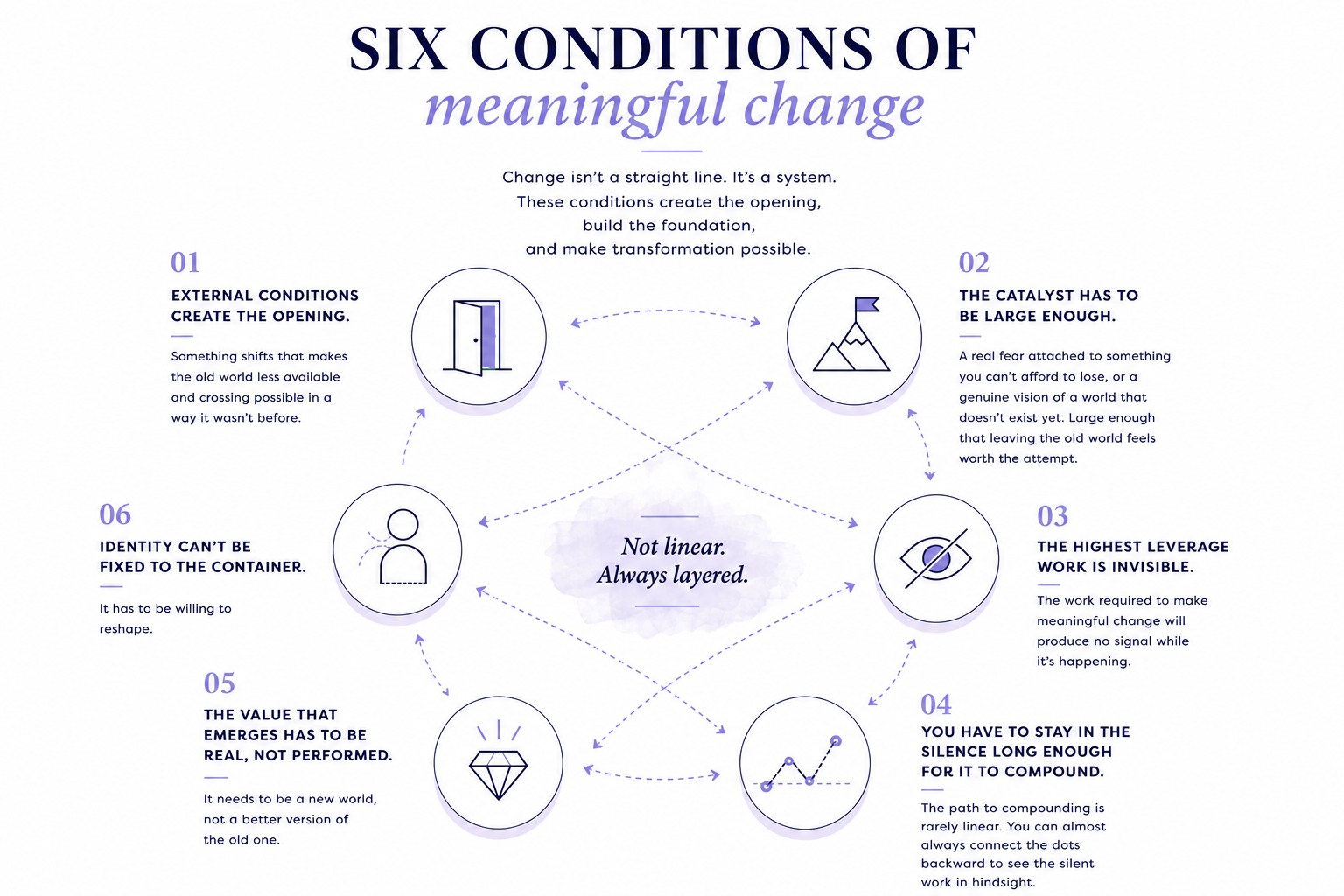
THE SIX CONDITIONS FOR MEANINGFUL CHANGE
Where the Framework Comes From
The framework originates in strategic narrative practice — the discipline of building product positioning that makes a B2B story actually land. After fifteen years of doing that work, three conditions became clear that the strategic narrative tradition names explicitly (the shift in the world, the stakes, the new world) and three more that it doesn't fully articulate but that real change seems to require (invisible work, surviving the silence, identity reshape).
The framework integrates both — the elements strategic narrative practice has refined, and the elements it tends to leave implicit. The Narrative Lens explains the origin in more detail.
The Six Conditions
One: External Conditions Create the Opening
Real change tends to require that the old world become less available. A disruption, a loss, a new technology, a door closing, a system shifting — something in the environment that makes staying where you are harder than it used to be.
The opening can't be manufactured. It arrives. And it makes crossing possible in a way it wasn't before.
In a strategic narrative, this is the shift in the world. In life, it's the external condition that makes the old container stop fitting.
Small changes — optimization, adjustment, the next decision in front of you — don't require this condition. The six conditions tend to activate only when the change is at the identity level.
Two: The Catalyst Has to Be Large Enough
Real fear tends to be the most powerful form of a large enough catalyst. Specific, personal, attached to something you can't afford to lose. The fear that moves you is already there — you can't manufacture it. The input doesn't create the urgency. It catches it.
But fear isn't the only catalyst that works. A genuine vision of a world that doesn't exist yet can be equally large. Not mild dissatisfaction — not wanting things to be slightly better. A real pull toward something specific that isn't available in the current container.
Both tend to work. Both have to be specific and personal. The test is whether the catalyst is strong enough that losing the old world feels worth the attempt.
In a strategic narrative, these are the stakes — what the buyer stands to lose if they don't move. In life, it's the real fear or vision underneath the change. Most attempts at change fail at this condition. The catalyst is too small. The fear is manufactured rather than real.
Three: The Highest-Leverage Work Is Invisible
Real change tends to require work that produces no signal while it's happening.
Strategic narrative practice doesn't fully name this condition, but every company that has built something real has done it — the years of infrastructure, expertise, and foundation-building that the buyer doesn't see in the pitch but that makes the new world the pitch promises actually possible.
In a life, this is the work happening underneath that doesn't confirm itself. The training before the result. The reading before the breakthrough. The interior shift before the exterior life rearranges around it.
This is the condition that tends to break most attempts. Because the work is invisible, the measurement apparatus around you keeps directing attention and resources away from it. You shift effort toward what responds — the work that actually produces signal — and the invisible work that was actually building toward the change gets quietly deprioritized.
If you're only doing the work that produces a signal, you're not doing the work that actually changes things.
Read more about Invisible Work.
Four: You Have to Stay in the Silence Long Enough for It to Compound
This is the condition that tends to undo everything else, and the one strategic narrative practice almost never names explicitly.
After the catalyst arrives and you start doing the invisible work, there tends to be a long flat period where nothing visible is happening. Sometimes things feel worse, not better. The old world is gone but the new one hasn't formed. You're inside the silence.
The compounding tends to only happen on the other side of staying in. But the entire system around you is designed to reward switching — to switch to something that produces a signal faster, that confirms you're doing the right thing, that resolves the discomfort of nothing happening.
Most people stop right before the compounding starts. Not because they're not committed, but because the silence is doing exactly what it's structurally supposed to do, and it feels like evidence that the attempt isn't working.
The change you're trying to make is happening underneath. You just can't see it yet.
Read more about The Silent Period.
Five: The Value That Emerges Has to Be Real, Not Performed
You don't tend to find the real thing by aiming at it. You find it by staying in long enough.
In a strategic narrative, this is the promised land — the new world the product makes possible. The promised land has to be specific, believable, and genuinely different from the current state. A pitch that promises a slightly better version of the old world doesn't land. A pitch that promises a fundamentally different one does — but only if the value is real, built on actual capability rather than performed for the audience.
In a life, the same tends to be true. The change has to be a new world, not a better version of the old one. Different cravings, different defaults, different patterns. A place you couldn't have chosen from where you were standing.
Performed value looks the same from outside. The same surface metrics, the same outputs. But it doesn't hold. The change that was aimed at the surface evaporates because the underlying conditions weren't real.
The test isn't what the change looks like. It's whether the underlying relationship shifted.
Read more about Optimization vs Crossing.
Six: Identity Can't Be Fixed to the Container
The container — the job title, the company, the role, the way the world has known you — was always just the best available answer at the time. It wasn't who you are.
Strategic narrative practice doesn't fully articulate this condition either, but it tends to be underneath everything. The buyer who can't let go of the identity that came with the old way isn't going to cross to the new one, no matter how compelling the pitch.
In a life, when real change happens, the container stops fitting. Identity has to be willing to reshape, or the change can't hold. People who tie their identity tightly to one container can't adapt when the container changes. They optimize the old container until it collapses, or they protect the container at the cost of the life it was supposed to be in service of.
The people who navigate real change well tend to hold their containers loosely all along. That curiosity isn't instability — it's the most adaptive position available when the rules are breaking faster than they used to.
How the Conditions Relate
These aren't sequential steps. You don't move through them once. You run into them, miss them, circle back. But all of them tend to need to be true.
Condition one (the opening) and condition two (the catalyst) initiate the crossing. Conditions three (invisible work) and four (silence) are what you do inside it. Condition five (real value) confirms whether you arrived somewhere new. Condition six (identity) is what has to be willing to reshape for any of it to hold.
If condition one isn't there, you're trying to leave a world that's still available, and the pull to stay will win. If condition two isn't large enough, the work tends to not sustain itself through the silence. If three is happening but four breaks — you stop too soon — the compounding never arrives. If five isn't real, you've optimized rather than changed. If six is rigid, no amount of work in conditions one through five can hold the new world in place.
The failure mode of any specific attempt at change tends to be traceable to one of these conditions not being true. The diagnostic isn't "did I try hard enough." It's "which condition wasn't real."
When the Framework Applies
These conditions are about identity-level change. Crossing from one version of a self, a company, or a life to a fundamentally different one.
They aren't about optimization. Optimization is the right move when the current container is genuinely working and you're trying to improve inside it. Eating better. Working out. Tightening your sales process. Hiring more carefully. These don't tend to require the six conditions.
But when the current container has stopped working — when the career doesn't fit, when the product positioning is wrong, when the life you built is no longer the life you want — optimization can't fix it. The six conditions tend to be what's required for the actual crossing.
The most useful diagnostic is often distinguishing between an optimization problem and a crossing problem. Misreading the situation is one of the most common causes of stuck change.
Why the Framework Holds Across Domains
The same conditions tend to show up in films, companies, and lives because what's required for a story to land structurally is often the same as what's required for a real change to happen.
A film that stays with you tends to have all six conditions true for its protagonist. A product narrative that lands names a catalyst the buyer is already carrying, points at invisible work the company has done that makes new value possible, and offers an identity the buyer is willing to become. A life change that holds has worked through all six in some order.
This isn't a metaphor. The diagnostic move that finds what's structurally true underneath a film tends to be the same move that finds what's structurally true underneath a company's pitch or a person's transition.
The newsletter, The Layer Beneath, explores all three tracks essay by essay.
Applying the Framework
Reading the framework isn't enough to apply it. The diagnostic requires sitting with a specific situation and asking which conditions are true and which aren't.
The Narrative Lens explains the framework's origin in strategic narrative practice and walks through how to construct your own change narrative using the six conditions.
For worked examples of the framework across films, products, and life, start with the essays.