
IDENTITY-LEVEL CHANGE
When the container has to break and reshape
Condition six of the six conditions for meaningful change
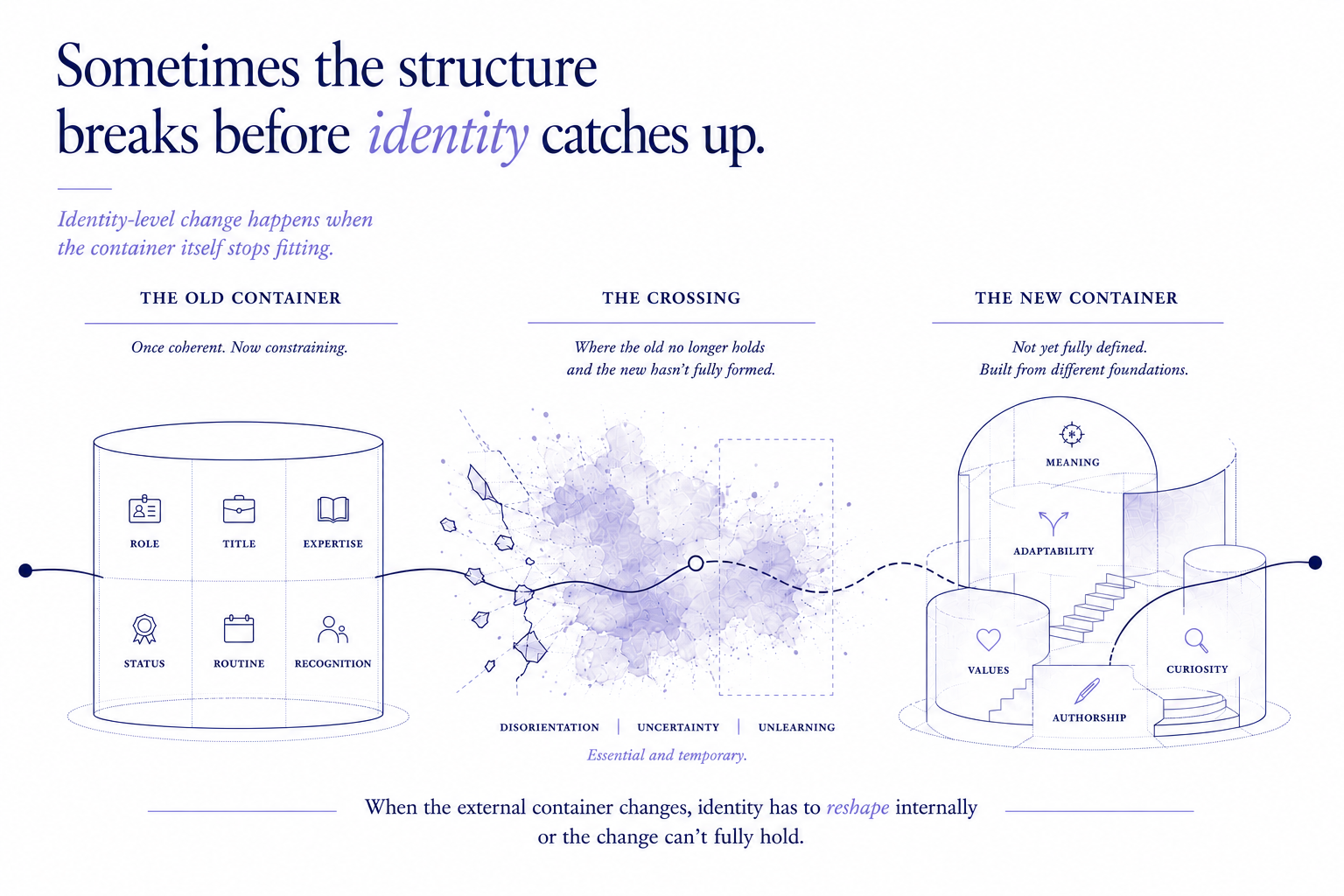
Identity-level change is the kind of change where who you are has to shift, not just what you do. Most change happens at the level of behavior, routines, habits, or circumstances — the container still holds. Identity-level change is different. The container itself stops fitting, and the version of you that existed inside it no longer fully matches what your situation requires, what you want, or who you've already quietly started becoming underneath.
This is often the condition that determines whether a crossing actually holds. Without identity reshape, the change can't take root, no matter how much work happens underneath.
Identity-level change is becoming more common because the external world is changing faster than it used to. The roles people built stable identities around are becoming less stable. AI is accelerating this pressure across entire categories of knowledge work. The container that the world recognized you inside may no longer exist in the same form in five years.
Why It Matters
When the external container changes, identity has to reshape internally or the change can't fully hold. People who fuse identity tightly to a single container often struggle most when the container shifts. They optimize the old structure harder and harder even as the returns diminish. They protect the identity at the cost of the life the identity was originally supposed to serve.
The people who adapt best often held identity more loosely all along. Not because they lacked commitment. Because they understood the container was provisional — the best available answer at the time rather than the final definition of who they are.
Signs You're Inside an Identity-Level Change
Your sense of who you are no longer fully fits your situation.
The work or life that once felt natural increasingly feels performed.
You're spending energy protecting an identity the world no longer responds to in the same way.
You can feel the old version weakening before the new version is fully visible.
You catch yourself describing yourself in the past tense.
The disorientation you're feeling seems larger than the practical changes happening on the surface.
You feel grief, resistance, curiosity, or fear that doesn't fully make sense at the level of logistics alone.
Common Failure Modes
Protecting the container at the cost of the life
The identity itself becomes more important than the person living inside it. Energy shifts toward defending who you were rather than discovering who you're becoming.
Grabbing the nearest available identity
The uncertainty of identity reshape becomes emotionally intolerable. You adopt a new identity prematurely simply to escape the discomfort of not knowing.
Performing an identity that hasn't fully formed
You begin publicly acting like the new version of yourself before the underlying shift has actually happened. Eventually the gap between performance and reality becomes difficult to sustain.
Refusing to let the old identity die
You continue insisting you are fundamentally the previous version of yourself long after the structure supporting that identity has disappeared.
Mistaking surface changes for identity reshape
You change titles, environments, aesthetics, or routines without the underlying relationship to yourself actually changing.
What Tends to Make Identity Reshape Work
Holding identity loosely from the beginning.
Tolerance for periods of genuinely not knowing who you are.
Curiosity about what's emerging rather than defense of what's disappearing.
Allowing the new identity to become specific rather than generic.
Enough time for the reshape to become real underneath before forcing clarity prematurely.
Examples Across Domains
In a film: The Devil Wears Prada
Andy Sachs almost completes an identity-level transformation before realizing the version of herself being shaped by Runway isn't actually who she wants to become. The deeper identity move isn't entering Miranda's world. It's recognizing the transformation as wrong for her and choosing differently.
In a show: Succession
Kendall, Shiv, and Roman are trapped because identity is fused to the Roy container. None of them can fully imagine themselves outside it even as the structure itself becomes increasingly destructive.
In a product
Companies that successfully reposition often undergo identity-level change internally first. They stop understanding themselves as one type of company before the market fully recognizes the shift.
In a life
A knowledge worker navigating AI disruption is often facing an identity-level question rather than simply a skill-development question. The issue isn't only "what new tools should I learn?" It's "Who am I if the work I built my identity around changes fundamentally?"
As a parent
Becoming a parent is one of the clearest examples of identity-level change. The version of you who existed before doesn't quite return. The people who navigate it well tend to allow the new identity to form rather than holding onto who they were before.
How Identity-Level Change Relates to the Framework
Identity reshape is what allows a crossing to hold long-term. The opening often forces the identity question into the open. The catalyst is frequently tied to fear or vision around who you're becoming. Invisible work and the silent period are often where the reshape is actually happening underneath.
By the time the new world becomes externally visible, identity has often already shifted internally.
Read More
For the full framework, read the six conditions.
For where the framework comes from, read the narrative lens.