
Invisible Work
The work that doesn't produce a signal while it's happening
Condition three of the six conditions for meaningful change
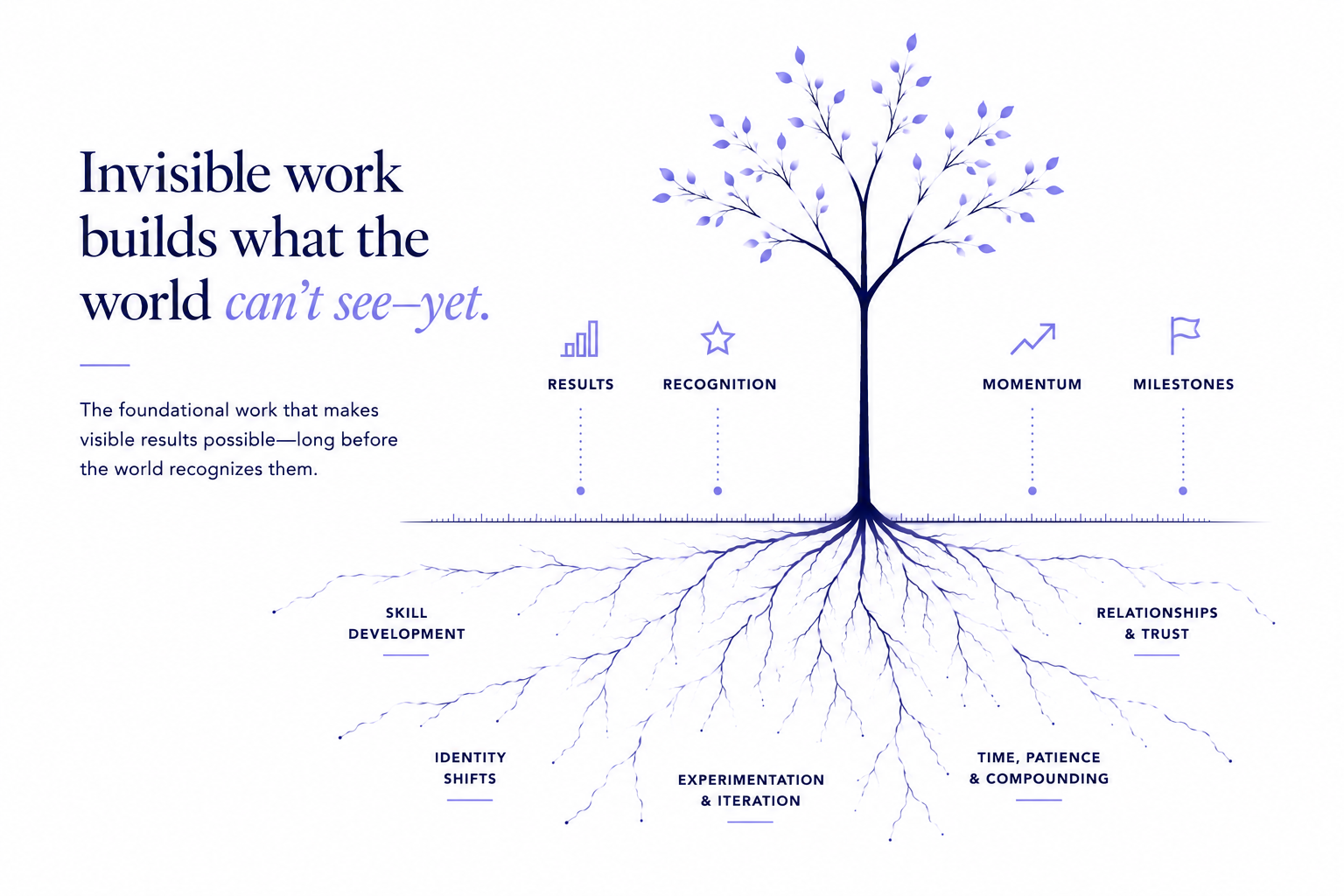
Invisible work is the work that has to happen for a meaningful change to become possible, but that produces little or no visible signal while it's underway. It's not simply a metaphor for unappreciated labor, though there's overlap. It's a structural condition — the kind of work whose value can usually only be recognized in retrospect, once it has compounded into something the world can finally register.
This is the condition that breaks most attempts at meaningful change. Every system around the work is designed to reward what produces a signal, which means foundational work that produces no signal gets systematically deprioritized, even when it's the most important work being done.
In a company, invisible work is the foundational engineering, infrastructure, hiring, positioning, and systems work that has to happen before a product is ready to scale. In a career, it's the reading, relationship-building, pattern recognition, and capability development that happens before a new role or opportunity exists. In a life, it's the interior shifts that happen before the exterior structure rearranges around them.
Why It Matters
Invisible work is often the highest-leverage work in any system pointed at real change. It's also the work most likely to be deprioritized — by managers, by institutions, by measurement systems, and by the brain of the person doing it.
The reason is structural. Every system around the work is designed to reward what produces a signal. Dashboards measure outputs. Reviews evaluate visible accomplishments. Social systems reward visible progress. Even your own sense of momentum tends to respond to feedback. When work produces no visible response, the system gradually starts treating it as if it isn't happening. The rational response becomes redirecting effort toward work that does respond.
The result is that the work most necessary for meaningful change often receives the least reinforcement. People migrate effort toward what confirms itself. The invisible work — the work that would have actually changed the situation — slowly gets crowded out by work that produces faster but shallower signals.
If you're only doing work that produces a visible signal, you're probably not doing much work that actually changes things.
Signs You're Inside It
You're working hard and nothing visible is happening yet.
The measurement systems around you are reading your progress as flat or declining even though you can feel something shifting underneath.
The advice you're getting is to switch. To optimize what's visible. To focus on faster feedback.
You can articulate why the work matters, but you can't yet point to proof.
You find yourself defending why you're spending time on something the dashboard isn't rewarding.
The work feels meaningful even though the environment around you isn't confirming that.
You suspect the change is real underneath, but you can't yet demonstrate it externally.
Common Failure Modes
Switching too early
The most common failure mode is abandoning the invisible work right before it compounds into something visible. Because the work has produced no signal for so long, the rational case for stopping begins to look overwhelming. Most people stop here. The people who don't often look unusually disciplined from the outside, but what usually separates them is simpler: they stayed in long enough.
Migrating effort toward surface work
A subtler version of switching. You don't abandon the invisible work outright. You just start allocating less and less energy toward it because the visible work produces clearer returns. Over time, the invisible work becomes too small a percentage of your effort to actually compound.
Performing work for an audience that needs a signal
When stakeholders need visible progress, but the real work isn't externally legible yet, the temptation is to produce artifacts of activity. Slides, updates, public-facing performance. Sometimes these are necessary. But often the performance starts consuming the exact time and energy the underlying work needs to become real. The visible performance crowds out the actual thing.
Confusing invisible work with directionless work
Not all work without a signal is foundational. Some work produces no signal because it isn't actually pointed at anything. The diagnostic isn't "Is this work visible?" It's "if this work compounds successfully, does it make the new world more possible?" Sometimes the answer is no.
Interpreting silence as evidence of failure
Invisible work and the silent period are different conditions, but they often overlap. The work itself produces little visible response, and the surrounding environment stays quiet. Together, the two conditions reinforce the feeling that nothing is happening. Often, the structure is operating exactly as it needs to.
What Tends to Make It Work
The work usually needs to be attached to a real catalyst. Invisible work without a meaningful fear, tension, or vision underneath it tends to dissolve. The people who sustain invisible work through long periods of silence usually have a reason large enough to keep pulling effort toward the work even when no feedback is arriving.
The work also has to be defensible internally. The people doing invisible work that eventually compounds are often able to articulate why the work matters long before they can prove it externally.
The work usually has to be protected from systems designed to discount it. This often means intentionally protecting time for it, accepting that some visible metrics may temporarily stagnate, and resisting pressure to optimize only for what's measurable.
The work also has to be honest about its timeline. Foundational work compounds on a real timeline. Pretending something that structurally requires years can happen in weeks is its own form of failure.
Examples Across Domains
In a film: Hidden Figures
Katherine Johnson, Dorothy Vaughan, and Mary Jackson are doing work that nobody at NASA fully recognizes for most of the film. The mathematics making the mission possible, the FORTRAN expertise preparing the computing department for the future, the engineering credentials opening the next era — all of it happening underneath systems not designed to register the value yet. The work produces little visible signal until the moment it becomes impossible to ignore. By then, it has already compounded into something the institution finally has to recognize.
In a product: Stripe
Stripe spent years building infrastructure for online payments before the product was usable at the scale it eventually reached. Most of the foundational work wasn't buyer-visible. Internal tooling, reliability, edge-case handling, compliance infrastructure, and developer experience refinement. By the time Stripe's product looked simple from the outside, the invisible work underneath was already enormous. The simplicity worked because the foundation was real.
In a life
A person who eventually transitions out of a career they've outgrown often spent years doing invisible work first. Reading, exploring, building relationships, developing skills, quietly clarifying what they actually wanted. From outside, the transition looks sudden. From inside, it's often the moment the invisible work finally became visible enough for the world to register.
As a parent
Most of what shapes a child happens in unwitnessed moments — the daily presence, the patience held through difficulty, the values lived rather than stated, the years of repetition that don't register anywhere. None of it shows up in any measurable form. But it compounds into who the child becomes. The work disappears into the person.
How Invisible Work Relates to the Other Conditions
Invisible work usually requires a real catalyst to sustain it through long stretches without feedback. The silent period is often the external environment surrounding invisible work. The value that eventually emerges is what the invisible work was quietly building toward. Identity reshape often happens through invisible work before the exterior life catches up.
By the time the new version becomes visible externally, much of the work has already happened underneath.
Read More
For the full framework, read the six conditions.
For where the framework comes from, read the narrative lens.
For essays exploring invisible work in depth, see: