
OPTIMIZATION VS CROSSING
Why some problems need refinement, and others require a fundamental shift
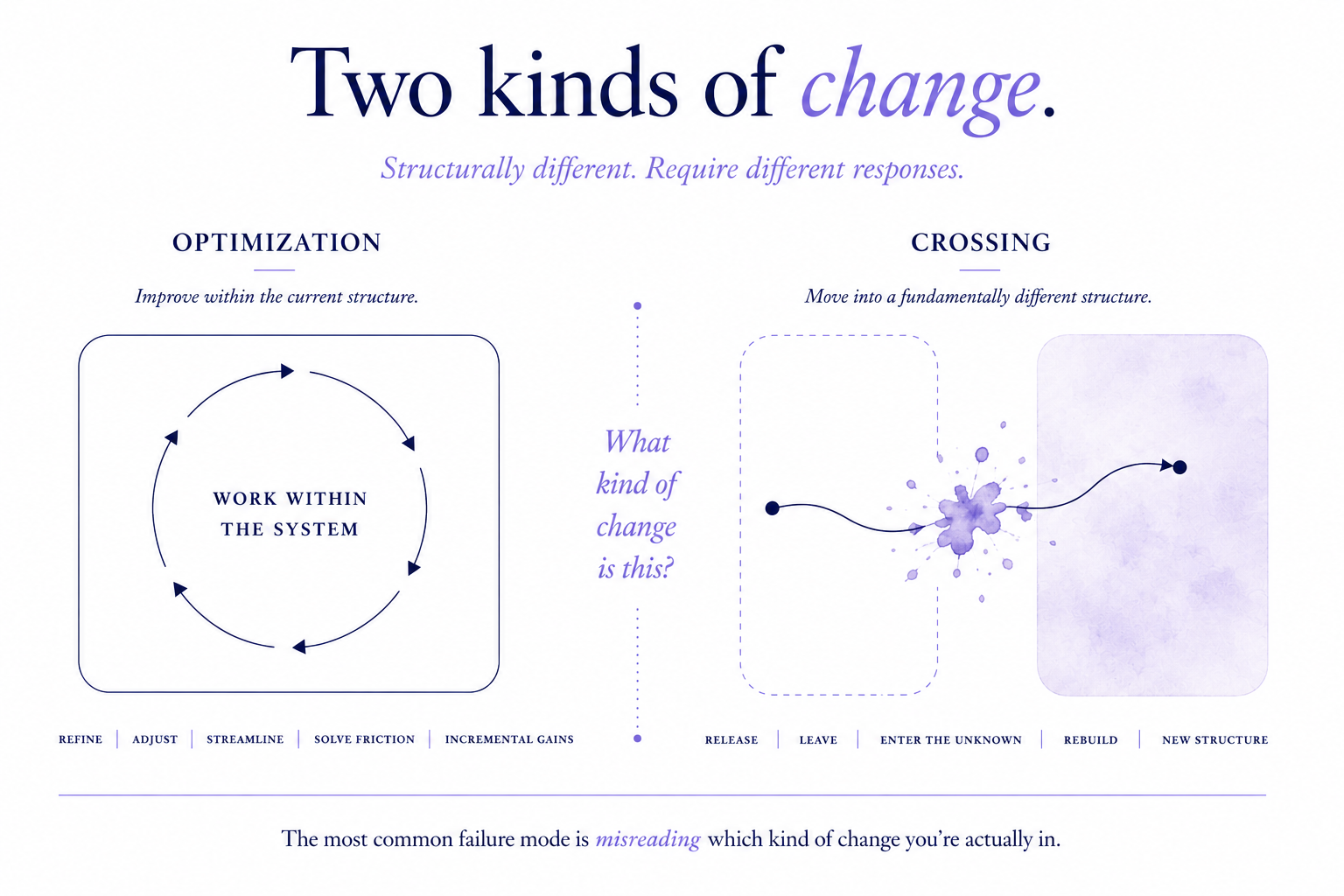
Optimization is improving inside the current container — refining the existing role, system, product, or life. Crossing is moving into a fundamentally different one. These are structurally different kinds of change. Optimization works when the underlying structure is still fundamentally sound. Crossing becomes necessary when the container itself has stopped fitting.
Most attempts at change fail at a specific diagnostic moment: misreading whether the situation requires optimization or a crossing.
This distinction sits underneath the entire framework. The six conditions for meaningful change apply specifically to crossings. Optimization doesn't usually require them. Knowing which kind of situation you're inside is the first move that makes the rest of the framework useful.
Why It Matters
Treating an optimization problem like a crossing creates unnecessary upheaval. Treating a crossing problem like an optimization is usually worse. You apply more discipline, systems, strategy, and effort to a container that fundamentally no longer fits. The effort produces smaller and smaller returns because the issue isn't execution anymore. It's a structural mismatch.
This is part of why burnout can become so confusing. Sometimes the problem really is workload, systems, boundaries, or execution. But sometimes the exhaustion is the body's correct response to optimizing a container that no longer matches who you are or what the situation requires.
The diagnostic matters because optimization and crossing require fundamentally different responses.
Signs You're in an Optimization Situation
The container still fundamentally fits.
Effort produces proportional returns.
The friction points are specific and addressable.
Your identity still largely fits the role or life you're in.
A reasonable outside observer would probably say, "This is fundamentally working."
Signs You're in a Crossing Situation
The container itself has stopped fitting.
Effort produces diminishing returns.
The pain points feel diffuse and accumulating.
You increasingly feel like you're protecting an identity attached to the old container.
The work or life that once felt meaningful starts feeling strangely performed.
A reasonable outside observer would probably say, "No amount of optimization is going to fully solve this."
Common Failure Modes
Optimization burnout
You continue applying increasing discipline to a situation that actually requires a crossing. The effort produces smaller and smaller returns until exhaustion becomes unavoidable.
Premature crossing
You abandon something that was fundamentally working because the friction felt unbearable. The problem wasn't a structural mismatch. It was a solvable optimization issue.
Performed crossing
You change the surface container without the underlying structure actually changing. New city, new job, new identity language, same underlying relationship to the work or life.
Endless deliberation
You remain stuck trying to determine whether the situation requires optimization or crossing while committing fully to neither.
Optimizing through what should be a crossing
The most common and expensive failure mode. You continue to find smaller optimizations because admitting that the container itself no longer fits feels too destabilizing.
What Tends to Make the Diagnostic Work
Honest assessment of whether the container still fundamentally fits.
Looking carefully at where effort goes versus what it produces.
Noticing whether identity itself feels threatened.
Tolerance for the possibility that the answer may be unwelcome.
External perspectives from people who understand structural change.
Examples Across Domains
In a career
A senior PMM who's exhausted but still deeply energized by the actual work may be inside an optimization problem. A senior PMM who's increasingly resentful of the work itself may be inside a crossing problem. The distinction matters.
In a product
Strong retention with weak acquisition is often an optimization problem. Weak retention and weak acquisition are usually more structural. Improving the funnel doesn't fix a product that fundamentally no longer fits the market.
In a relationship
Some relationships need repair. Others involve underlying incompatibilities that no amount of communication optimization can fully solve.
In a life
Sometimes the life itself no longer fits. Optimization only delays the crossing.
How the Distinction Relates to the Framework
The six conditions for meaningful change primarily apply to crossings. Optimization doesn't usually require all six conditions. Crossings do.
This is why one of the most useful diagnostics is simply determining which kind of situation you're actually inside. Misreading the structure tends to produce all the wrong responses.
Read More
For the full framework, read the six conditions.