
THE SILENT PERIOD
Why progress feels invisible right before it compounds
Condition four of the six conditions for meaningful change
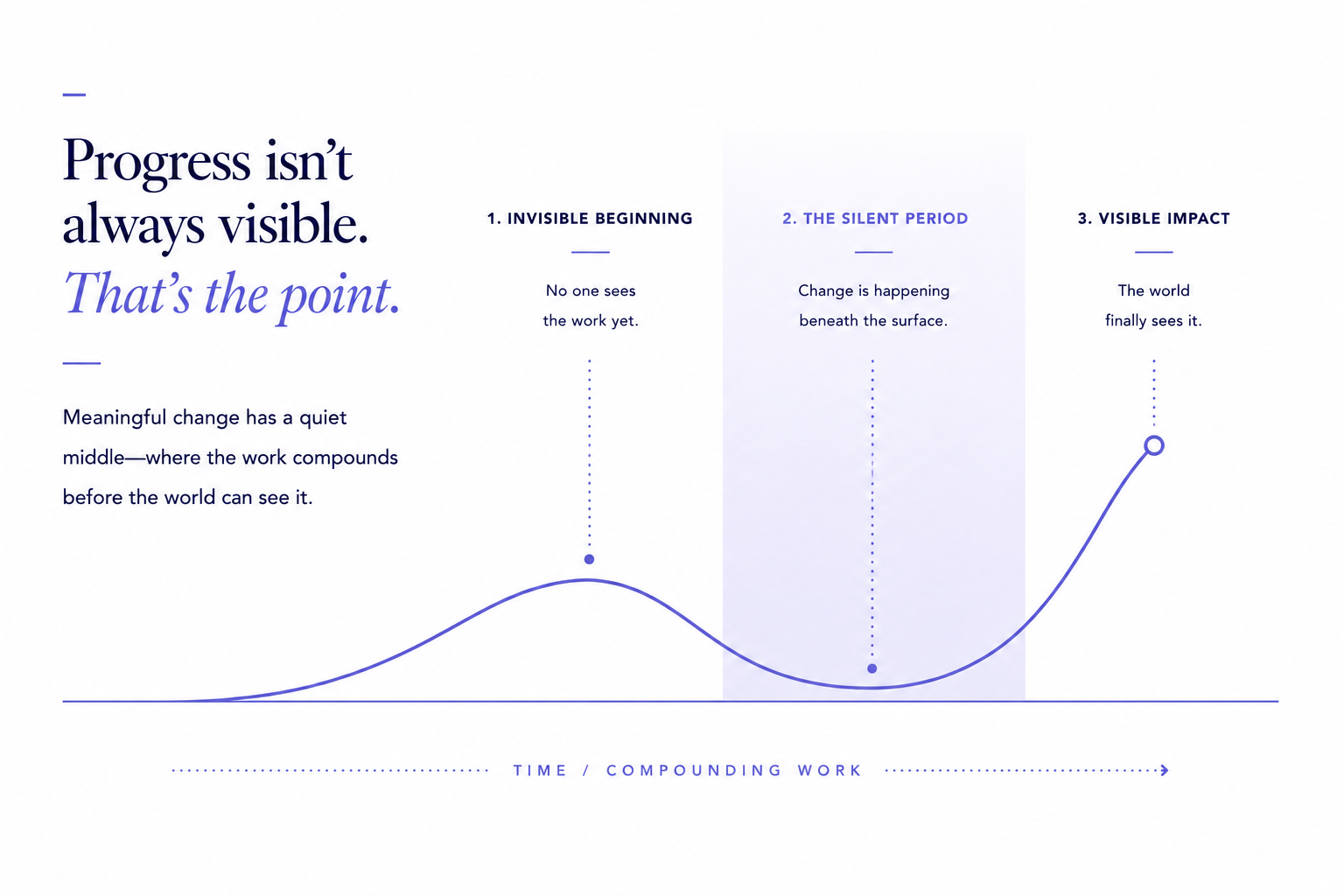
The silent period is the long flat stretch during meaningful change when nothing visible seems to be happening. The catalyst has arrived. The invisible work is underway. But the external environment remains silent — and sometimes things temporarily deteriorate before they improve.
This is the condition that undoes most attempts at change. The silent period is structurally designed to make you stop, because the rational case for abandoning the change becomes strongest exactly when staying in would have allowed it to compound.
The silent period isn't the same thing as invisible work itself, though the two often overlap. Invisible work describes what's happening in the work. The silent period refers to the world's response to the work, which is often nothing.
Why It Matters
The silent period is structurally designed to make you stop. Every system around you reads silence as evidence of failure. Your brain reads it that way, too. The advice you receive often assumes the same thing. The rational case for switching to something that produces a clearer signal becomes increasingly persuasive right at the moment staying in may be what would have allowed the compounding to happen.
Most people stop here. Not because they're weak or unserious. Because from inside the silence, there is often no reliable way to distinguish between "this is failing" and "this hasn't compounded yet."
The compounding often happens abruptly, not gradually. The work accumulates underneath the surface until some threshold is crossed and the change finally becomes externally visible. Before that threshold, the situation can feel indistinguishable from failure. Afterward, it can look inevitable.
The people who navigate change well are often the people who eventually stop interpreting silence itself as evidence that something is wrong.
Signs You're Inside It
The work is happening, but nothing around you is confirming it.
You're past the initial excitement of starting the change and into the long middle where the outcome still isn't visible.
You can't tell whether you're making progress or whether you're stuck.
You're increasingly tempted by changes that would produce faster feedback.
The people around you have stopped asking how it's going or started asking differently.
You catch yourself wanting visible artifacts of progress simply so the silence feels less unbearable.
You feel worse than you did before the change started, but can't fully explain why.
The old world no longer fits, but the new one hasn't fully formed yet.
Common Failure Modes
Stopping right before the compounding
The most common failure mode. The silence often becomes hardest right before it ends because the rational case for stopping becomes strongest exactly when the visible payoff still hasn't arrived.
Switching to something with a faster signal
Rather than abandoning change entirely, you redirect effort toward changes that produce more immediate feedback. Usually, these are smaller, optimization-shaped changes. Sometimes they work in their own right. But they often aren't the crossing the situation actually required.
Manufacturing visible progress
When the silence becomes emotionally intolerable, people often begin creating visible artifacts of activity that don't meaningfully contribute to the underlying change. The performance temporarily relieves the discomfort while quietly delaying the real work.
Looking for confirmation in systems built for the old world
The silence often persists because the systems designed to measure the old world aren't yet capable of recognizing the new one. Trying to force evidence out of those systems keeps producing the same answer: nothing.
Confusing silence with stuckness
Silence and genuine stuckness can feel identical from inside. The difference is whether the work itself is real and whether the catalyst underneath it is large enough to sustain the crossing.
What Tends to Make It Work
A clear relationship to the catalyst underneath the change.
An honest understanding of the timeline. Most meaningful changes take longer than people expect. Career shifts often take years. Identity-level changes can take even longer.
External witnesses who understand the structure rather than the immediate signal.
A relationship with silence that doesn't require immediate resolution.
Tolerance for periods where things genuinely feel worse before they improve. This phase is often structurally part of the crossing itself.
Examples Across Domains
In a film: The Pursuit of Happyness
Most of the film takes place during the silent period. Chris Gardner is doing the work while every visible signal suggests failure. He's sleeping in shelters. He's not making money. Nothing externally confirms the change is working. The visible compounding doesn't arrive until the very end.
In a product
Many successful product companies go through long periods where the product is improving underneath while the market hasn't yet responded. Founders often describe this as the wilderness period. The companies that survive it are often the ones whose founders could recognize structural progress before the market fully validated it.
In a life
Many meaningful personal changes involve long stretches where the work is real underneath but almost nothing visible has changed yet. The compounding appears later. Sometimes much later.
How the Silent Period Relates to the Other Conditions
The silent period often sits directly on top of invisible work. The catalyst underneath the change is usually what allows someone to survive the silence long enough for compounding to occur. The value that eventually emerges is what the silence was quietly protecting while it accumulated. Identity reshape frequently happens during the silent period before the external world fully registers the change.
Read More
For the full framework, read the six conditions.
For essays exploring the silent period, see: